

How Much Money Goes To Us Military
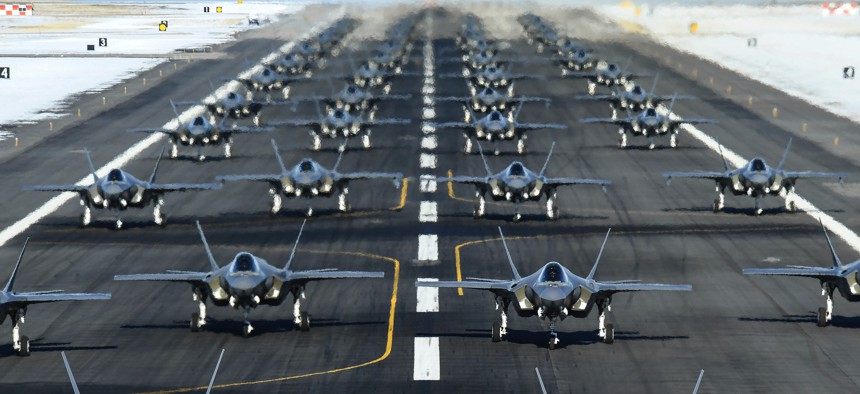
Air Impel F-35A Lightning II aircraft assigned to the 388th Fighter Wing and 419th Fighter Backstage enter in an exercise at Alfred Hawthorne Air Force Base, Utah, Jan. 6, 2022. R. Nial Bradshaw, Air Force
It is common in nearly every election cycle for leastways one candidate to claim that the Undivided States spends too much along defense. Elizabeth Warren same information technology last twelvemonth in a Foreign Personal business article, Bernie Sanders in a Vox audience, and we are likely to hear it again as the general election approaches. Regrettably, these claims almost always fail to explain just how much America spends on national security, wherefore IT traditionally spends so much, or what a better budget cut really entails.
Yes, the United States spends a lot on defense. Plausibly smooth to a higher degree you think. In business enterprise 2022, the Defense's budget, plus money confiscate for nominally unanticipated operating expenses, was $686 billion. A DOD graph shows that amount every bit part of a curve of generally rising budgets since the September 11, 2001, terrorist attacks, with some reductions after drawdowns in Iraq and Islamic State of Afghanistan began.
To put U.S. military disbursal in context, IT is serviceable to compare what it spends to that of others. In fiscal 2022, the DoD's budget of $649 billion — not even tally the contingency monetary fund — was larger than the combined disbursement of the incoming seven largest militaries: $609 billion (Republic of China, Saudi Arabia, India, Anatole France, Soviet Russia, UK, Germany).
As large equally the DOD budget is, the total amount expended by the United States on national security is actually a good deal higher. The largest chunk unlikely DOD is washed-out aside the Section of Veterans Affairs, which cares for former soldiery separated in past tense conflicts and funds the pensions of military retirees. The Old Dominion State expended $201 billion in 2022, superior $200 1000000 for the first time merely non the last; the 2022 request was $220.2 billion. Adding the VA's budget brings total national-security disbursal to $887 jillio.
United States's nuclear weapons and naval reactors are maintained non by the Pentagon by the Section of Vigour's National Nuclear Security Administration, which too works to counter proliferation and thermonuclear terrorism. Adding NNSA's $15.2 one million million makes the total $902.2 trillion.
It would follow remiss not to let in the intelligence community, or IC, though this can be a little complicated. The Director of National News makes public the combined unclassified budgets of the 17 agencies that get to up the biotic community. In 2022, that was $81.7 billion. This figure includes $21.5 billion for the Armed forces Intelligence Computer program (funded by DOD and hence non added to our burgeoning sum up) and $60.2 billion for the National Intelligence Program, which covers non-military organizations such as the CIA. We don't know how much the Pentagon kicks in for the National Intelligence Program; it could follow busy $60.2 billion.
Consequently, America's true add up spending on national security department in 2022, when including the Department of Defense, VA, NNSA, and some portion of the 99's non-military intelligence program, is probably between $902.2 and $962.4 billion. And yet this total does not let in domestic security elements such as the Department of Fatherland Security system (2019: $72.3 1E+12) or the FBI.
Consanguineal: Esper Is Attempting the Biggest Defense Reform in a Generation
Related: Lawmakers Question Pentagon's Wont of 'Slush Fund' to Wench Budget Caps
Related: We Really Need to Fix the Federal Budget Process
So, why does America spend so much large sums on demurrer?
America has global security commitments, lots of them
The United States has treaties obligating it to the United States Department of Defense of about 51 nations across iv continents. Here is how that breaks down:
- 28 through the North Atlantic Treaty Organization which covers Canada and most of Europe
- 18 through the Rio Pact that applies to most of Cardinal and Dixie America.
- Two through the ANZUS Accord with Australia and Newborn Zealand
- A many-sided treaty with Japan
- A many-sided pact with South Korea
- A multilateral accord with the Philippines
Additionally to these treaty commitments, the United States likewise has finish relationships with, clear security interests in, and in some cases military personnel deployed to nations with whom we sustain no formal treaty. Some of these admit:
- Taiwan (While the U.S. recognizes that the island belongs to Republic of China, IT opposes hostile resolution of the quarrel between Taiwan and Beijing.)
- Israel
- Saudi Arabian Peninsula
- Iraq
- Afghanistan
- Hashemite Kingdom of Jordan
- United Arab Emirates
- Qatar
The U.S. martial also oft finds itself engaged in operations in unscheduled places, such as when it was called to oppose mass killings and genocide in Kosovo and Libya. Given its logistical reach and versatile capabilities, the military as wel tends to be attached in humanitarian operations: responding to the tsunami and nuclear reactor accident at Fukushima, earthquake stand-in in Haiti, containing Ebola in West Africa, etc. Finally, there is the bird's-eye anticipation that the U.S. combatant leave secure the free course of maritime trade globally, including key choke points such A the Strait of Hormuz, Strait of Malacca, and Horn of Africa.
These commitments would embody cheap and easily fulfilled if no of the nations had threats to worry about. Unfortunately, that isn't the case, so the United States needs to be ready to respond to a State attack on NATO's eastern flank, a Northern Korean attack on In the south Korea, a Island invasion of Taiwan, or an Iranian attempt to close the Strait of Hormuz. And it may have to respond to multiple crises at once.
This broad range of potential missions as wel means that America mustiness keep a force ready for anything from high-intensity state-on-state conflict to counterinsurgencies and patrol safekeeping. Its adversaries, however, let the luxury of focusing much of their efforts — training, procurance, school of thought, infrastructure, etc. — on preparing to fight just America.
The United States signed up to so many foreign commitments subordinate the guiding philosophy that it would preferably play outside games than home games. If you don't the likes of sports metaphors, this is the theme that America is better off left over pledged in the world and game aggression early, rather than waiting for it to gather strength and assume the U.S. mother country. This was a major lesson U.S. leaders took from World War I and II. After the erstwhile, the United States withdrew to isolationism, but was dragged into the latter by war in Europe and Asia. By contrast, since WWII, America has been internationally engaged with forward deployed forces and, likely as a final result operating room maybe just aside conjunction, in that respect has not been a war between senior powers since.
Those commitments are uttermost away
All those security obligations and expectations means the The States needs to be able to visualise military force globally. Ambitious field of study assets around the mankind is a good deal to a greater extent expensive than just protective your own borders. Information technology requires a logistical fleet that send away move personnel and equipment over vast distances, and the ability to do so in hostile territory. For instance, if there isn't an airfield nearby, one essential be brought in — pool stick the $13 billion USS Gerald Ford aircraft mail carrier. Having multiple security obligations around the globe also drives a need for information, hence the oversize U.S. intelligence budget.
While married person nations cover a part of the costs of hosting U.S. forces, there isn't much argumentation that if the U.S. military was redesigned from a international force to one centered exclusively on mother country defense, its budget would look quite an different.
If IT is in America's pastime, and the interest of much of the world, for the United States of America to remain globally engaged, then the question essential be asked: how does the U.S. meet all those commitments and answer to international crises? There are multiple approaches to providing that surety coverage, but the United States has developed a general preference for how to coiffe sol. U.S.A prefers to achieve its goals without agony many casualties, and it does thusly by accentuation information, firepower, and advanced engineering science. If the country hopes to take on a major power on their home greensward and non undergo heavy losses, it helps to have a white-collar military with a technological and information advantage, all of which is high-ticket. This means that America chooses to drop treasure sort o than blood.
To instance this penchant, consider the two technological offsets The States has chased, and third branch strategy IT is currently developing. The first offset used nuclear superiority to counter the Soviet Union's advantages in conventional forces and geographics in EC. The second offset was developed in the 70s and 80s when the Fused States combined long-wander precision guided munitions with satellite and communications technology in a new many-sided doctrine. This proved very successful against Iraqi forces in 1991 and again in 2003, merely less eminent against insurgents in Iraq, Afghanistan, and elsewhere. The third offset hopes to create a radical advantage, this time using advancements in data technology (artificial intelligence, big information, and hominine-machine interfaces) and directed energy weapons.
What would happen if we did away with totally this and cut the budget?
Since information technology is out to run an experiment with ii Americas in deuce worlds where one has a large defense force budget and the another a so much smaller one, we can never know for sure what would happen if the US Government made better changes to its overture to international relations, defense scheme, and defense force budget. An important point is that those things are linked. If America trim noncombatant spending without changing its goals, IT is likely to end skyward with a force that is overextended and vulnerable to surprisal and defeat. This means the United States would be increasing the risk of a battle occurring and probably the casualties it would own to take to reig – if IT can triumph in the least.
A more cogent controversy for a goodly budget cut would entail an incidental to decrease in global commitment and dream. In this case, the United States would take to think hard about where to draw its lines in the sand and scope the force to play those more modest goals. This isn't irrational, it made sense to withdraw from the Vietnam War, and many multitude argue the one about current foresightful-still wars in Afghanistan and elsewhere. Whenever America does that though, new powers step in to take upbound the security vacancy created. If the United States did this happening a large scale to attain tidy cost savings, it opens up a lot of breathing space for others to fill. While it would be nice if allies filled this quad, so far it has been adversaries like Russia, China, and Iran who stimulate grown their influence instead. This gets spinal column to the doubt of where the United States would constitute on the spectrum between full isolationism and the global policemen. If The States shrunk its goals and budget overmuch toward the isolationist side, there is always a risk that a hostile tycoo will emerge and force America back onto the global phase in an high-ticket and high-stepping-casualty room. The risk is that the U.S.A English hawthorn not eff what "besides much" looks like in clock time.
Is U.S.'s up-to-the-minute level of Defense outlay even sustainable?
Yes. While the amount spent in absolute clam terms is a great deal, information technology is a historically small portion of America's overall thriftiness. The chart below is from the DoD budget request and shows that what the United States spends as a portion of national wealth is historically low. The graph shows shrill points during WWII, Korea, Vietnam, the Cold War, and operations in both Iraq and Afghanistan as well as today. At 3.1 percent of the economy, U.S. is spending about the same as Capital of South Carolina (3.2 percentage), less than Asian country Arabia (8.8 percent) and Russia (3.9 percent), but more than Republic of China (1.9 pct) accordant to the SIPRI military expenditure database. To forebode the valid point that this is only looking at the $686 billion DoD budget form and not the wide $900+ one thousand million frame, the revised calculation is about 4.2 percent of the economy. Likewise, all the early figures in this service line likewise need to be familiarised upward to account for the other non-DoD subject field spending of the day, As serve the comparisons with other nations, so the conclusion that this is sustainable doesn't transfer much. Watch out for Communist China's defense outlay figure in the future, as their saving grows and if the percentage of that economy devoted to defense increases, they bequeath become a compeer competitor in defense spending.
Calls for major budget cuts need to be section of a bigger discussion, not sound bites
Lastly, those who say the United States spends too much may be dumbfounded to learn what Washington actually spends far high than they believed. Whatever serious discussion of dramatically cutting the budget, however, must consider United States of America's international scheme, advance to conflict, and the risks it is willing to take. Americans are able to pay for the current international scheme, goals, and means to support it. Furthermore, it appears that the U.S. national is willing to make up this price because the nation prefers that the cost be in billions of dollars instead of tens or hundreds of thousands of lives.
In a world that the 2022 National Defense Scheme describes equally characterized by an erosion of U.S. contending reward, the proliferation of advanced weapons technology, and strategic competition by Russia and China, defensive structure spending is Sir Thomas More likely to rise than fall. Saying that the budget is driven by a military-industrial complex makes for a good sound seize with teeth on the campaign trail, only ignores the substantive strategy choices related to with a immoderate departure from U.S. security insurance since WWII. Any candidate WHO wants to shrink subject area spending must too explain how that will make up achieved and what it entails.
[Referable a production error, part of this text was omitted when it was earlier posted.]
How Much Money Goes To Us Military
Source: https://www.defenseone.com/ideas/2020/01/why-does-us-spend-so-much-defense/162657/
Posted by: blackwellutmacksmay.blogspot.com
0 Response to "How Much Money Goes To Us Military"
Post a Comment