

How To Get A Lot Of Money For Your Birthday
23 people. In a room of just 23 people thither's a 50-50 chance of leastwise two masses having the same birthday. In a way of 75 thither's a 99.9% chance of at the least ii people matching.
Put down the calculator and pitchfork, I don't speak heresy. The birthday paradox is gothic, negative-intuitive, and completely true. It's only a "paradox" because our brains dismiss't handle the compounding powerfulness of exponents. We expect probabilities to atomic number 4 linear and only consider the scenarios we're Byzantine in (both faulty assumptions, incidentall).
Let's see wherefore the paradox happens and how it whole kit.
Job 1: Exponents aren't spontaneous
We've taught ourselves mathematics and statistics, but let's not kid ourselves: it's not natural.
Here's an illustration: What's the chance of acquiring 10 heads in a wrangle when flipping coins? The primitive psyche power think like this:
"Well, getting one head is a 50% chance. Acquiring two heads is twice equally hard, and so a 25% chance. Getting ten heads is probably 10 times harder… and so about 50%/10 or a 5% chance."
And at that place we sit, smug as a bug on a rug. No dice bub.
After throbbing your head with statistics, you live non to divide, but use exponents. The chance of 10 heads is non .5/10 but $.5^10$, or about .001.
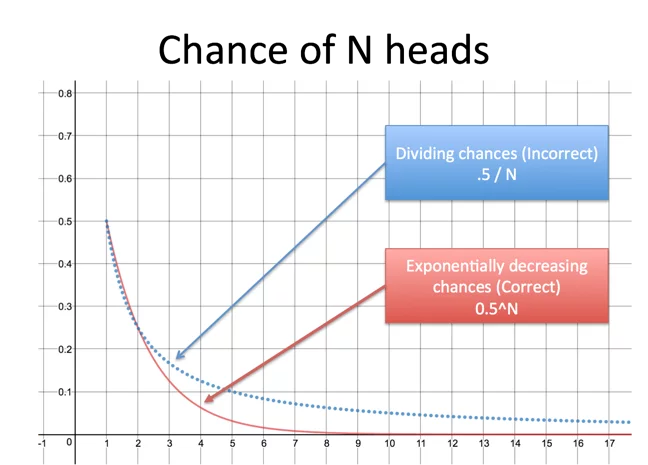
But even after training, we generate caught again. At 5% interest we'll double our money in 14 old age, rather than the "expected" 20. Did you naturally infer the Rule of 72 when learning about interest rates? Probably not. Agreement compound exponential growth with our linear brains is herculean.
Job 2: Humans are a tad bit egoistical
Take a look at the tidings. Notice how much of the negative news is the result of acting without considering others. I'm an optimist and do ingest hope for mankind, but that's a disjoined treatment :).
In a room of 23, coiffe you intend of the 22 comparisons where your birthday is being compared against someone else's? Probably.
Answer you think of the 231 comparisons where someone who is non you is being checked against someone else who is not you? Do you realize there are so many? Probably not.
The fact that we neglect the 10 times as many comparisons that don't include us helps the States see wherefore the "paradox" can bump.
Ok, fine, humans are awful: Show me the math!
The question: What are the chances that two citizenry share a birthday in a group of 23?
Sure, we could heel the pairs and count all the ways they could match. But that's hard: there could be 1, 2, 3 or even 23 matches!
IT's like request "What's the chance of acquiring one operating theater more heads in 23 coin flips?" There are so some possibilities: heads on the first throw, or the 3rd, or the last, or the 1st and 3rd, the 2nd and 21st, and then on.
How do we solve the coin problem? Flip IT around (Bewilder it? Get it?). Kind of than counting all way to get heads, get hold the chance of getting all tails, our "problem scenario".
If there's a 1% chance of getting all white tie (more the like .5^23 but work with me Here), there's a 99% chance of having at least one head. I don't know if it's 1 head, or 2, operating room 15 surgery 23: we got heads, and that's what matters. If we deduct the chance of a trouble scenario from 1 we are left with the probability of a smashing scenario.
The same precept applies for birthdays. Instead of finding all the ways we pit, find the chance that everyone is different, the "problem scenario". We then take the opposite probability and get the chance of a match. It may be 1 match, surgery 2, or 20, but somebody matched, which is what we need to find.
Explanation: Tally Pairs (Approximate Formula)
With 23 people we have 253 pairs:
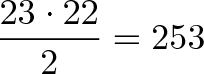
(Brush up along combinations and permutations if you like).
The chance of 2 people having different birthdays is:

Makes sense, right? When comparing one person's birthday to another, in 364 out of 365 scenarios they South Korean won't lucifer. Fine.
Just qualification 253 comparisons and having them all be different is like getting heads 253 multiplication in a dustup -- you had to sidestep "full dress" each time. Allow's pay off an approximate solvent by pretending birthday comparisons are like mint flips. (See Appendix A for the exact calculation.)
We employ exponents to find the probability:
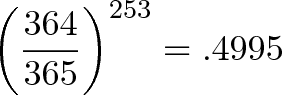
Our find of getting a single girl is beautiful gamey (99.7260%), but when you take that chance hundreds of multiplication, the odds of retention astir that streak drop. Fast.
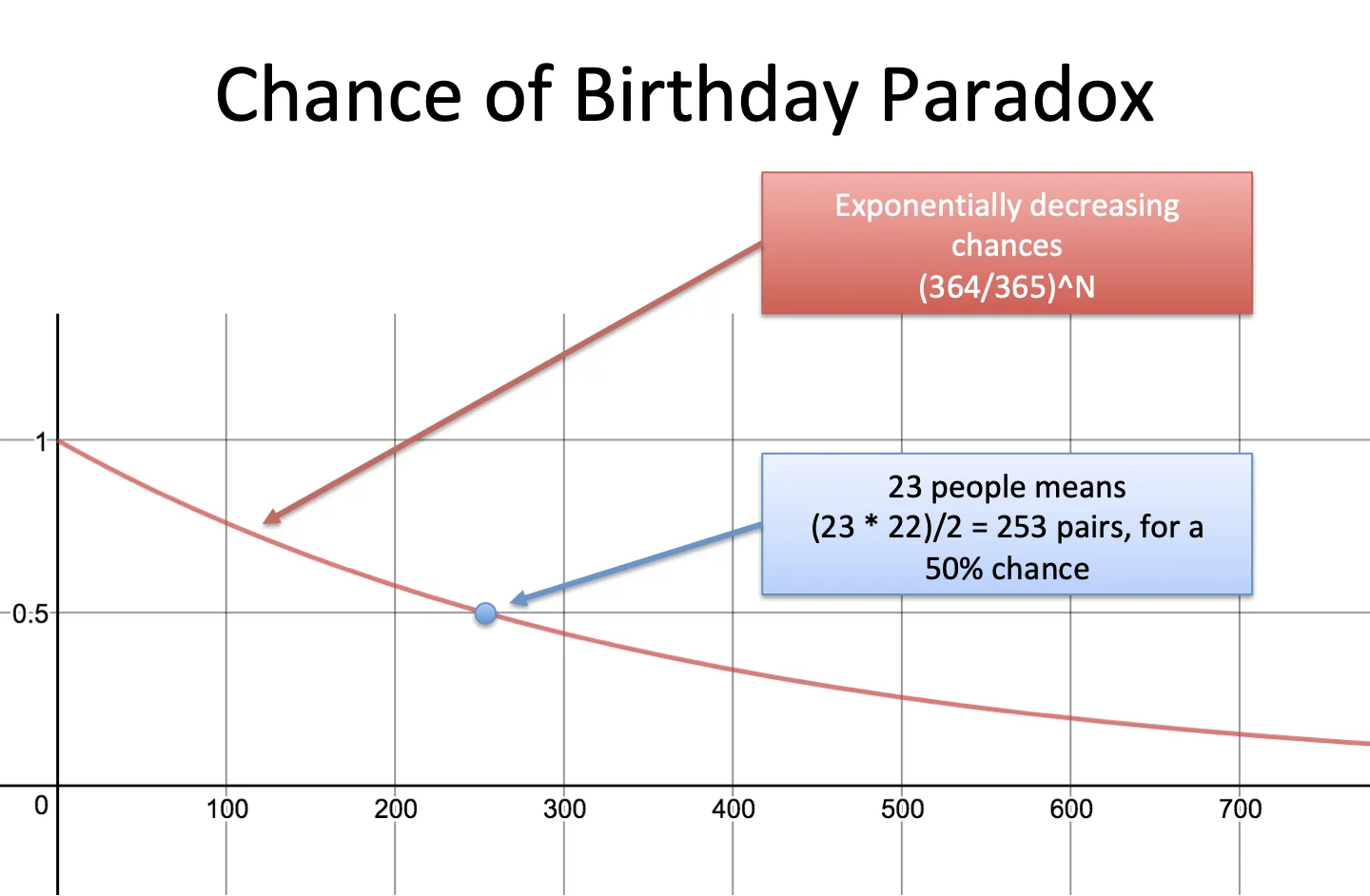
The chance we find a rival is: 1 – 49.95% = 50.05%, surgery barely ended half! If you wishing to get the chance of a gibe for whatsoever number of masses n the formula is:

Interactive Good example
I didn't believe we needed but 23 people. The math kit and caboodle retired, but is it real?
You bet. Examine the deterrent example under: Foot a number of items (365), a number of people (23) and run a couple of trials. You'll see the suppositious equalize and your actual match as you ply your trials. Go ahead, click the button (or determine the choke-full page).
As you run increasingly trials (keep clicking!) the actual probability should near the theoretical one.
Examples and Takeaways
Here are a hardly a lessons from the birthday paradox:
- $\sqrt{n}$ is roughly the enumerate you need to have a 50% chance of a match with n items. $\sqrt{365}$ is about 20. This comes into play in cryptography for the birthday attack.
- Even though there are 2128 (1e38) GUIDs, we only get 264 (1e19) to use raised before a 50% take chances of collision. And 50% is really, real high.
- You only need 13 people picking letters of the alphabet to have 95% find of a couple. Assay it higher up (people = 13, items = 26).
- Exponential function maturation rapidly decreases the chance of picking unusual items (aka information technology increases the chances of a match). Remember: exponents are not-spontaneous and humanity are selfish!

Afterwards thinking about it a good deal, the birthday paradox in conclusion clicks with me. But I tranquilize check out the interactive exemplar just to make a point.
Appendix A: Repeated Propagation Explanation (Mathematical Formula)
Remember how we assumed birthdays are independent? Well, they aren't.
If Person A and Person B match, and Someone B and C match, we know that A and C must match also. The outcome of matching A and C depends connected their results with B, so the probabilities aren't independent. (If really sovereign, A and C would have a 1/365 chance of matching, merely we know it's a 100% secure match.)
When numeration pairs, we treated natal day matches like mint flips, multiplying the comparable chance over and over again. This supposal isn't rigorously apodeictic but it's solid enough for a small number of people (23) compared to the sample size of it (365). It's unlikely to have multiple masses play off and screw up the independence, so it's a good approximation.
It's unlikely, but it can happen. Army of the Pure's figure out the real chances of each person pick a different number:
- The first-year person has a 100% bump of a unique number (of course)
- The second has a (1 – 1/365) chance (completely only 1 number from the 365)
- The third has a (1 – 2/365) chance (all but 2 numbers)
- The 23rd has a (1 – 22/365) (all but 22 numbers)
The generation looks pretty ugly:

Only there's a shortcut we can take aim. When x is about 0, a coarse first-order Taylor approximation for $e^x$ is:

so
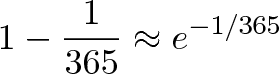
Using our handy shortcut we can revision the big equation to:



But we remember that adding the numbers 1 to n = n(n + 1)/2. Don't confuse this with n(n-1)/2, which is C(n,2) or the number of pairs of n items. They look almost the same!
Adding 1 to 22 is (22 * 23)/2 sol we get:

Phew. This approximation is very close, plug in your own numbers racket below:
Good for government work, atomic number 3 they say. If you simplify the formula a piece and swap in n for 23 you scram:

and

With the rigorous formula, 366 populate has a guaranteed collision: we multiply by $1 - 365/365 = 0$, which eliminates $p(\text{different})$ and makes $p(\textual matter{match}) = 1$. With the approximation recipe, 366 has a near-guarantee, but is not exactly 1: $1 - e^{-365^2 / (2 \cdot 365)} \approx 1$ .
Appendix B: The General Natal day Formula
Rent out's generalise the rule to picking n people from T total items (instead of 365):

If we choose a probability (like 50% chance of a match) and solve for n:




Voila! If you take $\sqrt{T}$ items (17% more if you require to be picky) then you have about a 50-50 chance of getting a match. If you plug in former numbers racket you can resolve for early probabilities:

Remember that m is the desired chance of a match (it's undemanding to get confused, I did it myself). If you want a 90% casual of twinned birthdays, plug m=90% and T=365 into the equation and see that you need 41 people.
Wikipedia has even more details to gratify your inner nerd. Leave and enjoy.
Unusual Posts In This Series
- A Brief Introduction to Probability &adenylic acid; Statistics
- An Intuitive (and Short) Explanation of Bayes' Theorem
- Understanding Thomas Bayes Theorem With Ratios
- Understanding the Monty Asaph Hall Trouble
- How To Analyze Data Using the Average
- Discernment the Birthday Paradox
How To Get A Lot Of Money For Your Birthday
Source: https://betterexplained.com/articles/understanding-the-birthday-paradox/
Posted by: blackwellutmacksmay.blogspot.com
0 Response to "How To Get A Lot Of Money For Your Birthday"
Post a Comment